
Approve load testing without signing a blank check
Your engineers already picked the tool. Gatling gives you the rest: public pricing, spend controls per team, a SOC 2 Type II report, and load generators that can run inside your own network.


The tool isn't what's blocking this. The missing answers are.
The request on your desk came from an engineer who ran a proof of concept and has no budget authority. You didn't see the demo, and there's no budget line. These four questions are why "not this year" feels like the safe answer.


What will this cost per year?
Finance wants one predictable number. Usage-based pricing and unknown test volumes make that hard to give.

Why pay more than we pay today?
The quote gets compared to the current tool or to free open source, not to the cost of a failed launch.

Can our data stay inside our network?
Banks, insurers and public bodies often can't let test data, scripts or traffic leave their perimeter.

Will it pass security and legal review?
Security questionnaires, DPAs and contract redlines add months when the vendor's documents aren't ready on day one.
THE ANSWERS
Four questions. Four straight answers.
Each answer is documented before your review starts, so the engineer who sent you this page doesn't have to improvise.
Public pricing from €1,068 a year
Basic is €1,068/year. Team is €4,272/year with 10 seats, 3 load generators and 5 hours of testing. Enterprise is quoted on your test plan: a routine month, a peak month and a launch-day test.
Spend controls per team
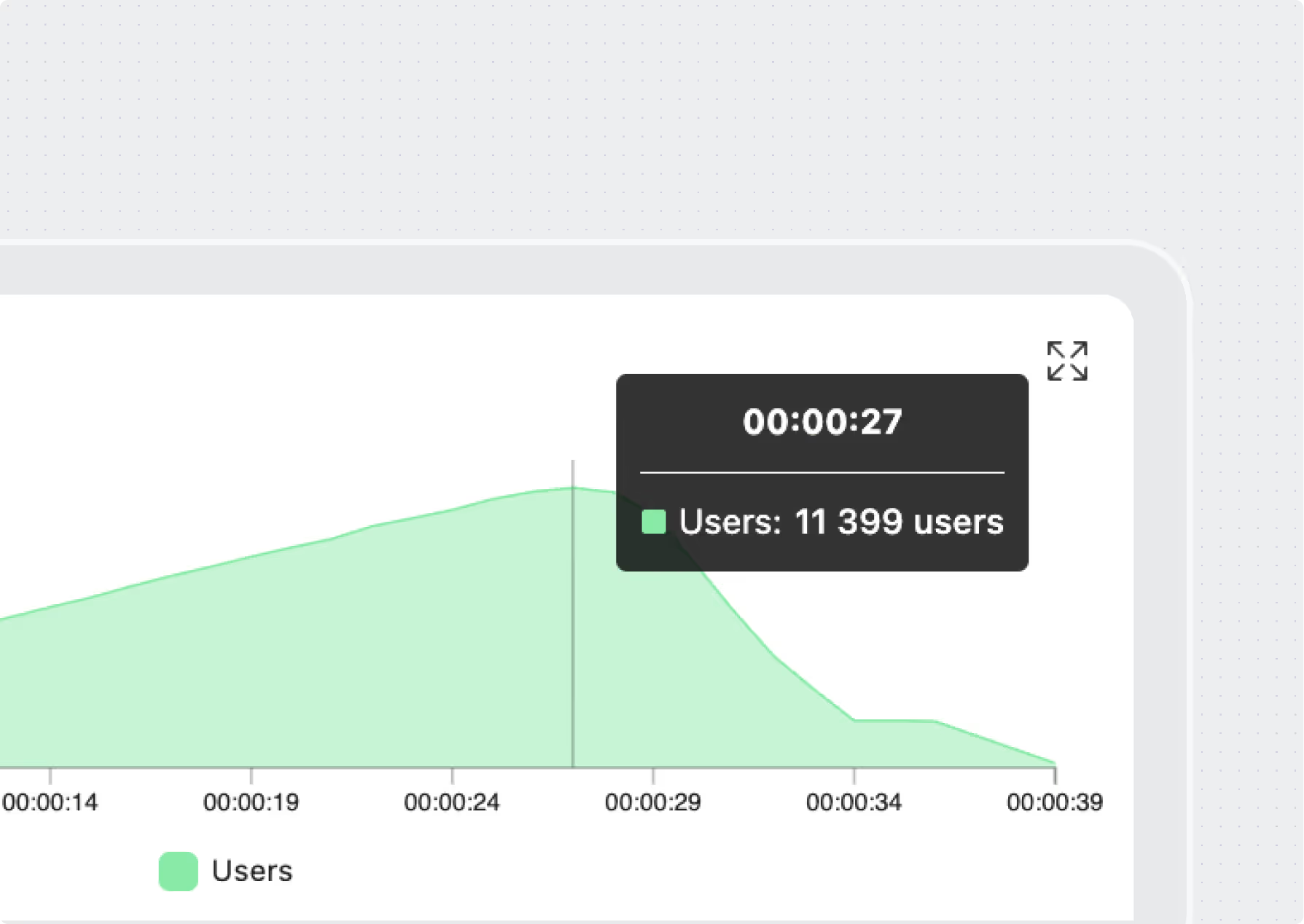
Set credit quotas per team and track usage on a dashboard. Stop rules end a run when error rates or response times cross a threshold, and a cancelled CI pipeline cancels its test.

Lower total cost, not just a lower license
The asynchronous engine runs up to 60,000 virtual users on one load generator. Thread-per-user tools need 10 to 20 times more compute at equivalent load.

Data stays inside your network
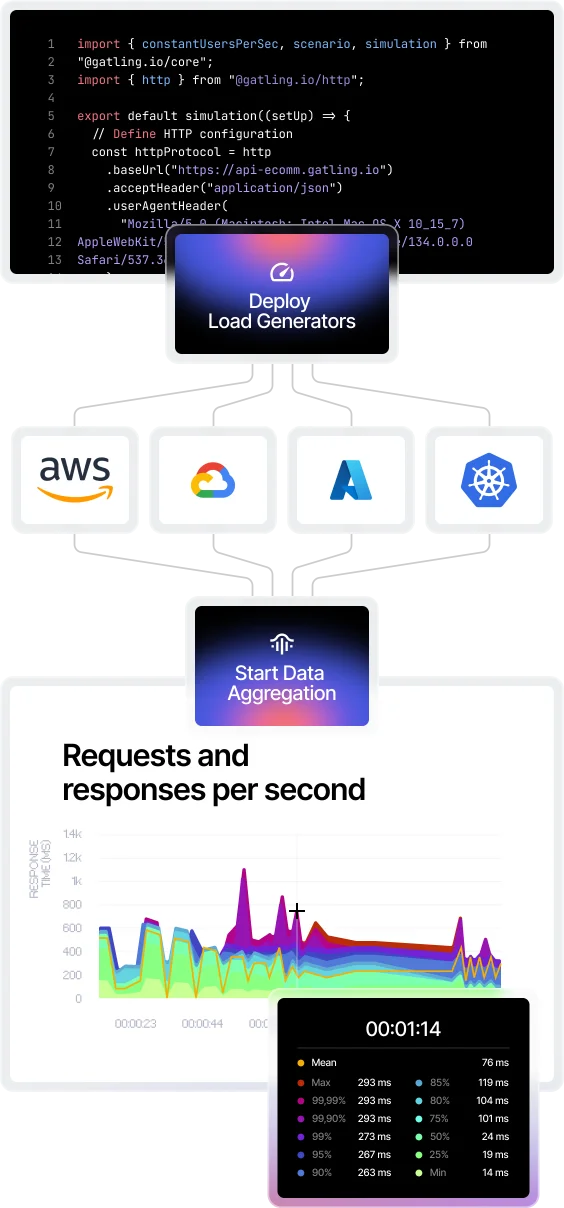
Private Locations run load generators in your AWS, Azure, GCP, Kubernetes or on-premises environment. The agent connects outbound only, and with private packages Gatling never receives your test code.

Ready for security review
SOC 2 Type II report and a public trust center. SSO through SAML or OIDC with identity-provider groups mapped to roles, role-based access, scoped API tokens and GDPR compliance.
No lock-in
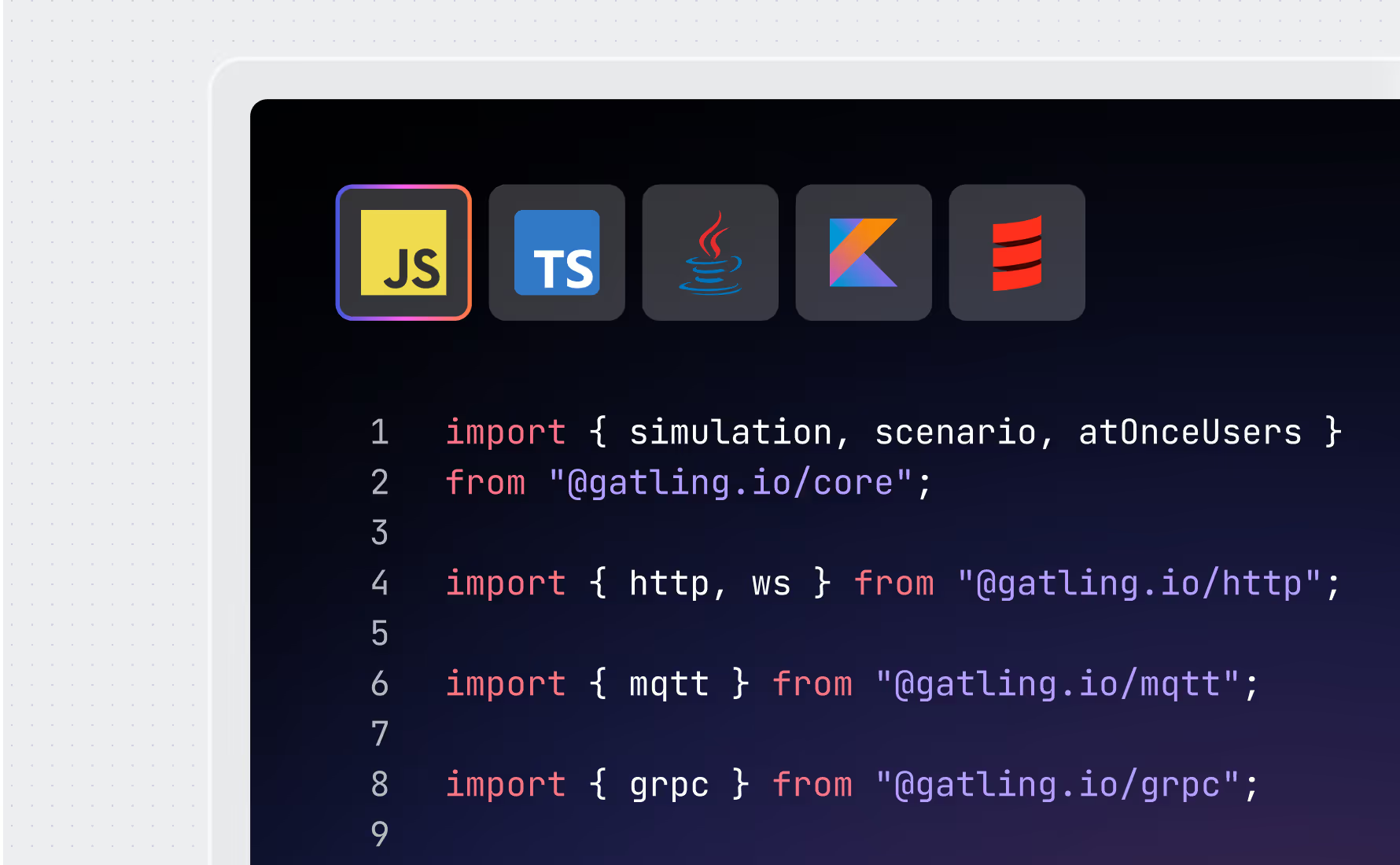
Tests are code in Java, JavaScript, TypeScript, Kotlin or Scala, stored in your own repositories. The open-source core is Apache 2.0. If you leave, your scripts leave with you.

CUSTOMERS
Approved by banks, payment schemes and fintechs
Regulated teams have already taken this purchase through procurement, security and legal. Here is what decided it for them.
Nickel (BNP Paribas) runs load generators inside its own on-premises environment through Private Locations, a compliance requirement for its banking application. Performance tests are a mandatory gate in its Change Advisory Board process. "Three years ago, releasing our core banking system meant days of stress. Today, deployments are stable and invisible to our users." Alexandre Baert, Pre-production Platform Manager, Nickel
Intuit consolidated 30 fragmented performance tooling solutions into one. Source code, scripts and proprietary libraries stay inside its network, and only latency and throughput numbers leave. Team provisioning and role assignment run through the Gatling API.
Backed by 16 European banks and acquirers, EPI Company runs Private Locations on AWS to reduce data egress and keep test infrastructure costs under control while testing JWT, mTLS and HMAC security flows.
Purse moved from JMeter to managed load generators because provisioning machines turned every test into an event that needed coordination. "The goal was to make testing a commodity, not an event where you have to mobilize people." Nicolas Zangari, QA lead, Purse
EU DORA Article 25 lists performance testing among the tests financial entities must run. The UK FCA and PRA, and APRA CPS 230 in Australia, require firms to stay within tolerances in severe but plausible scenarios. Test reports with pass/fail results and run history give auditors something to read.

FEATURED STORIES
Success stories powered by Gatling














Explore our other use cases
Gatling Enterprise Edition powers performance testing across industries and architectures. From web apps to AI workloads, see how teams use Gatling to validate reliability, scalability and speed, and release with confidence.
FAQ
Questions procurement, finance, InfoSec and legal ask us
Start on a public plan billed annually and expand when the budget cycle opens. Basic is €1,068/year, below most approval thresholds, and you can move to Team or Enterprise without rewriting a single test.
The open-source version is a solid engine, and it stays free. It runs locally, produces one static report per test, keeps no history and has no access control. Once several teams test, engineers end up building and running load infrastructure themselves. The paid platform replaces that work and puts it under a contract you can audit.
Set quotas per team, and set stop criteria that end a run when CPU, error rate or response time crosses a threshold. Usage dashboards show consumption by team.
Yes. Load generators running in your account use your compute, and you pay your cloud provider for it. That is the trade-off for keeping traffic and data inside your network. If data residency isn't a requirement, Gatling-managed generators include the infrastructure.
Everything your review needs, in one pack
Most of the waiting in a load testing purchase is waiting for documents. Send the pack to InfoSec, legal and finance on day one.
Need our security documentation?
Comparing vendors?
