
Load test your cloud infrastructure before
auto-scaling fails in production
Validate elastic scaling, multi-region performance, and cloud-native architectures with distributed load testing designed for modern cloud environments.


Why cloud testing breaks traditional tools
Cloud infrastructure requires dynamic scaling validation,
geo-distributed testing, and multi-tenancy considerations
that traditional tools simply cannot handle

Millions of concurrent
API calls
Mobile app launches and viral content create sudden spikes in backend API requests. Testing users locally tells you nothing about handling concurrent users.

Elastic resource management
Container orchestration, serverless functions, and managed services introduce dynamic resource allocation that requires sophisticated testing scenarios.

Geo-distributed performance
Multi-region deployments require testing from global locations to validate CDN performance, regional latency, and cross-zone data synchronization.

Multi-tenancy
resource contention
Shared cloud infrastructure creates unpredictable performance variations due to noisy neighbors and resource contention that affect application behavior.
FEATURE TOOLKIT
Cloud-native load testing designed for elastic infrastructure
Gatling's distributed architecture and cloud-first approach validates modern cloud applications under realistic conditions
Cloud-native observability
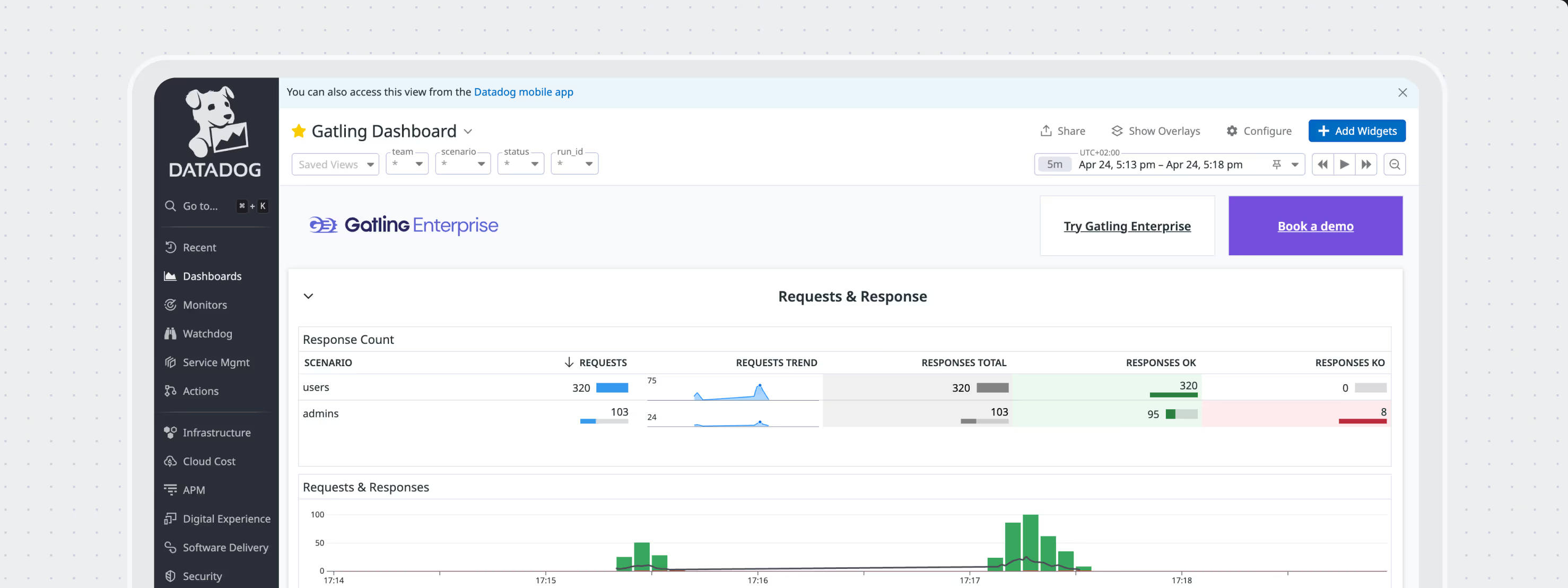
Stream Gatling metrics into Datadog or Dynatrace. Correlate load test results with infrastructure health, scaling events, and application telemetry in real time.

Geo-distributed load generation
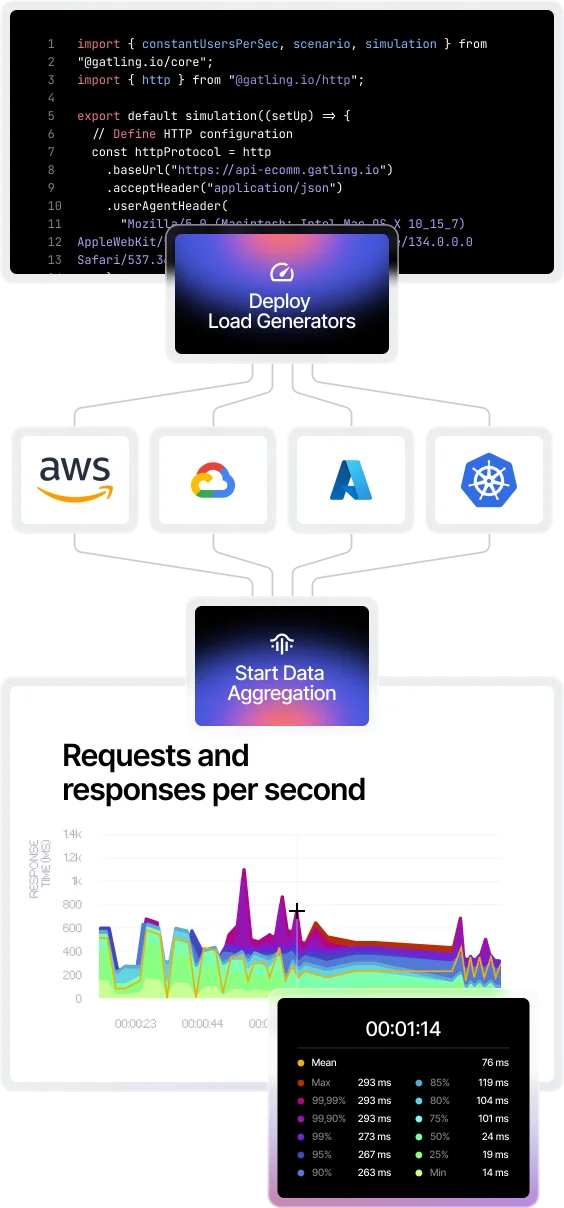
Spin up distributed load generators across multiple regions and providers to replicate real-world user traffic. Validate latency, CDN behavior, and multi-region synchronization under realistic conditions.
Elastic scaling validation
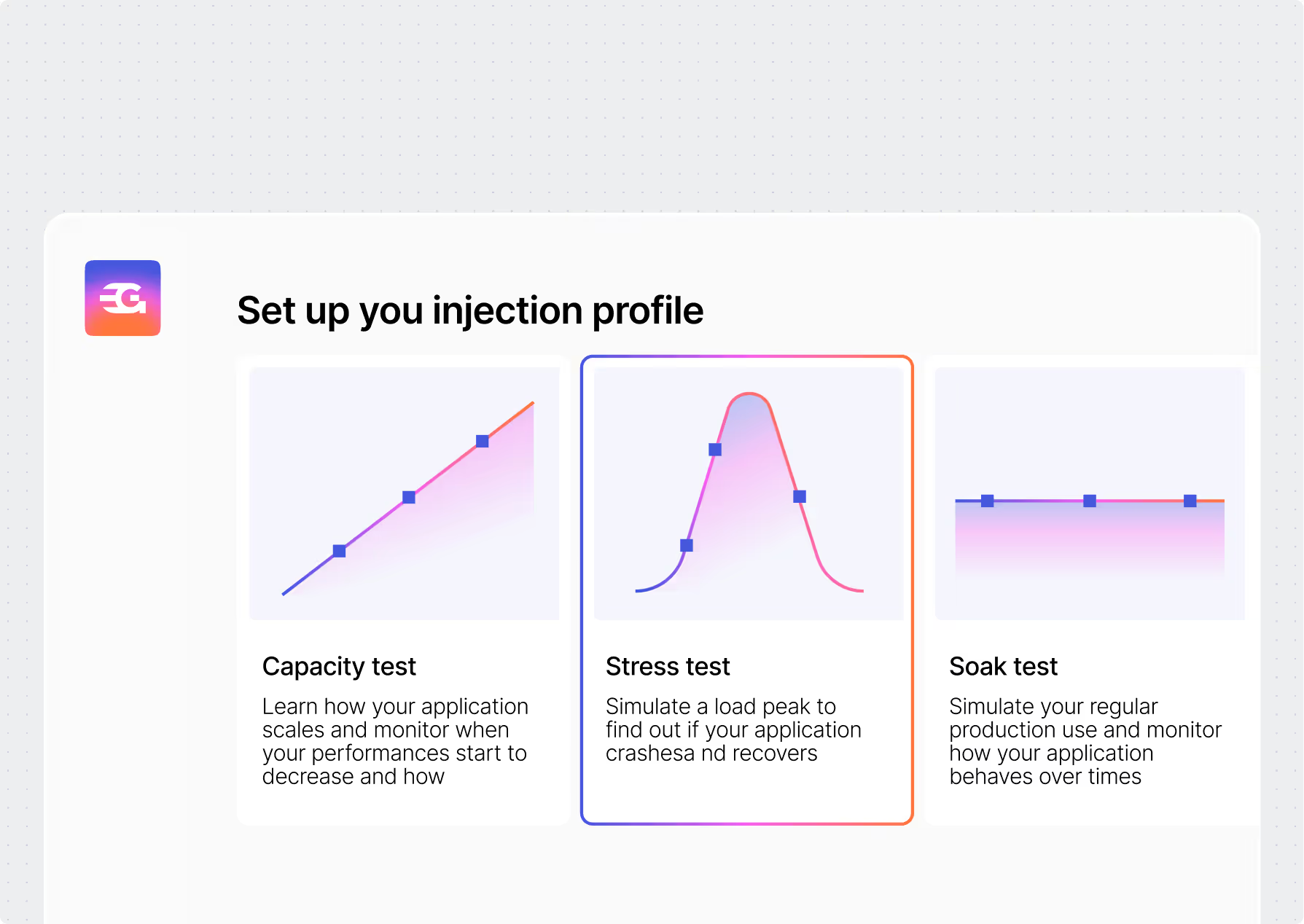
Use Gatling’s flexible injection profiles and distributed traffic generation to trigger scale-up/down events. Verify that Kubernetes pods, EC2 auto-scaling groups, and serverless functions respond as expected, and catch misconfigured rules early.
Cost optimization
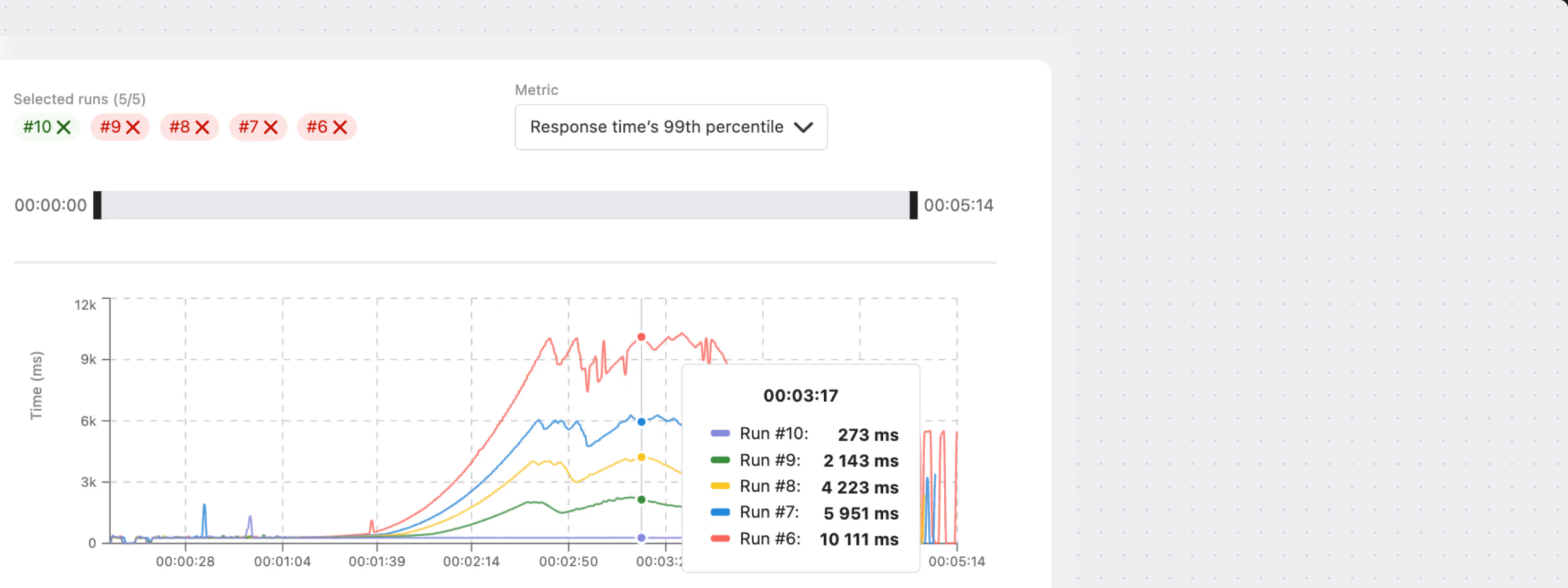
Run tests to right-size instances and compare performance vs. cost under realistic conditions, helping you avoid over- or under-provisioning.

CI/CD pipeline integration
Embed Gatling tests directly into your favorite CI/CD tool. Automate performance checks on every build or release so regressions are caught before they reach production.
Resilience & failover testing
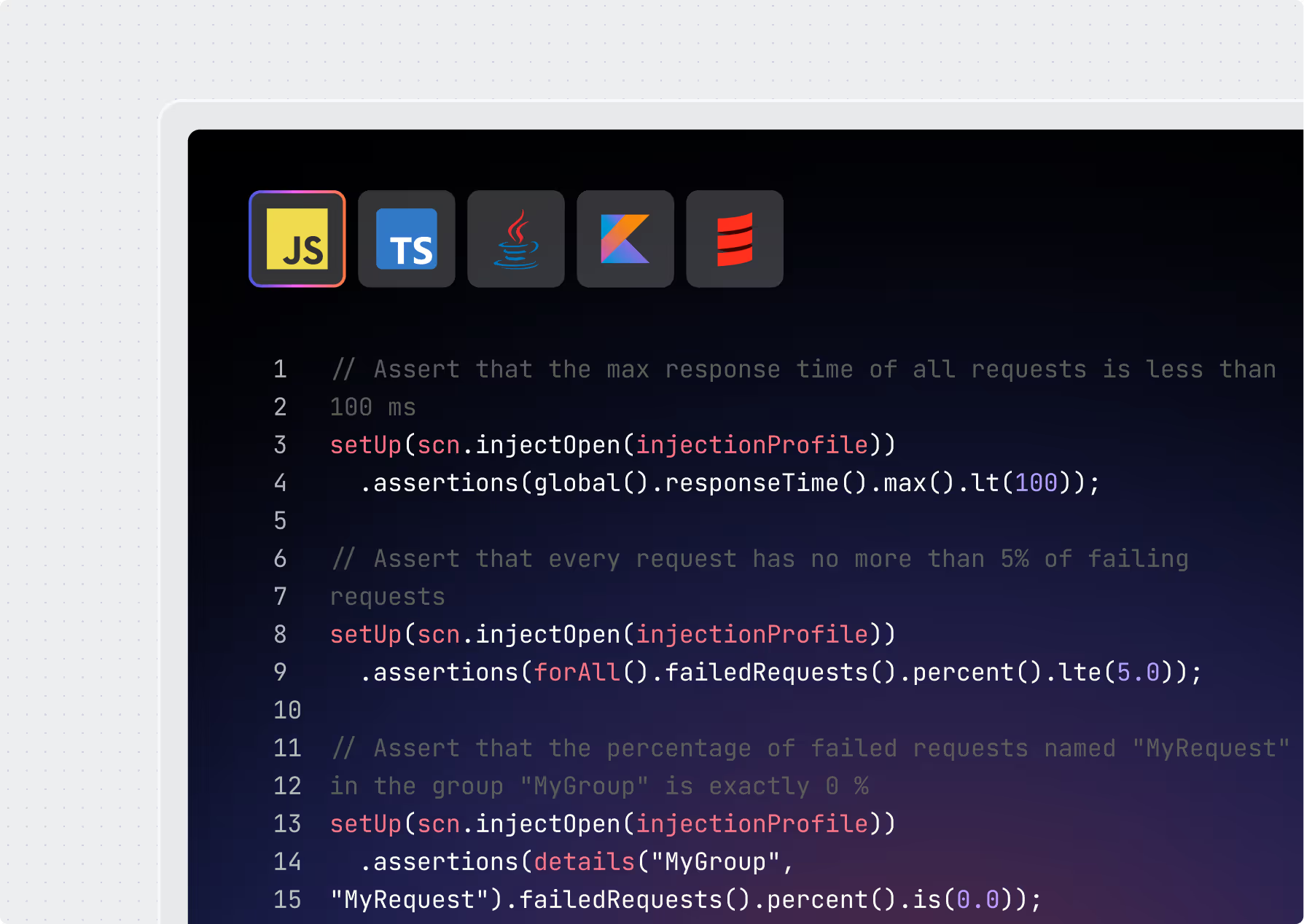
Sustain realistic traffic with distributed load generators while executing chaos experiments. Use Gatling’s performance assertions and trend reports to confirm that failover, disaster recovery, and multi-zone resilience strategies keep your application within SLA under real load.

USE CASES
Every cloud deployment needs performance validation
Whether it's migration, scaling, or optimization, when your infrastructure is in the cloud, performance testing is critical
Test that your Kubernetes HPA, EC2 auto-scaling groups, and serverless functions scale correctly under varying load patterns and traffic spikes.
Ensure application performance consistency during cloud migration. Compare on-premises vs cloud performance and validate migration success.
Validate global application performance across AWS regions, Azure zones,
and GCP locations. Test CDN effectiveness and cross-region failover.
Right-size cloud resources based on actual performance data. Optimize instance types, database configurations, and storage solutions for cost-efficiency.
Simulate intense traffic to mobile backends, GraphQL endpoints, and edge-facing services.Surface thread saturation, connection pool exhaustion, and backend contention by pushing your infrastructure to its limits.

FEATURED STORIES
Success stories powered by Gatling

.jpg)

.jpg)






.svg)






Explore our other use cases
Gatling Enterprise Edition powers performance testing across industries and architectures. From web apps to AI workloads, discover how teams use Gatling to validate reliability, scalability, and speed — and release with confidence.
FAQ
Frequently asked questions (FAQs) about load testing for cloud infrastructure
Traditional tools cannot handle dynamic scaling validation, geo-distributed testing requirements, multi-tenancy considerations, and the elastic resource management inherent in container orchestration, serverless functions, and managed cloud services.
Geo-distributed testing spins up load generators across multiple regions and cloud providers to replicate real-world user traffic patterns, validating latency, CDN behavior, and multi-region data synchronization under realistic conditions.
Gatling supports WebSocket, gRPC, JMS, MQTT, and other protocols, enabling comprehensive testing of hybrid AI applications and event-driven systems that combine multiple communication patterns.
Gatling pushes token throughput and concurrency to breaking points, testing whether infrastructure scales appropriately with AI compute demands. This prevents both overprovisioning that wastes money and underprovisioning that degrades performance.
P95 and P99 latency metrics reveal tail latency that averages miss, showing exactly when the slowest users start experiencing poor performance. These percentile metrics are critical for LLM apps where response times vary significantly.