
Why is Gatling the best load generation engine?
The high-performance architecture behind Gatling's load generation engine, and why it holds up when everything else starts dropping requests.
Get the full datasheet in your inbox
Everything on this page, as a PDF, for sharing with your team or your architecture review.
Common blockers to achieving your load testing goals
What engineering teams consistently run into when trying to run reliable, high-performance load tests.
Test architectures are complex to build and maintain
Standing up a reliable load testing environment takes heavy engineering effort.
- blockInability to simulate real concurrency due to blocking or thread-per-user models
- link_offFragile distributed setups that break under CPU, network, or configuration drift
- trending_downMetrics pipelines that drop samples or flatten peaks when throughput increases
- tuneHigh operational load just to keep generators and environments aligned
Even existing setups often fail to scale
Most engines saturate compute, memory, or sockets long before realistic traffic.
- speedLimited scalability caused by thread-per-user architectures
- memoryCPU exhaustion before real concurrency is reached
- boltUnpredictable throughput under bursts or TLS-heavy traffic
- warningInability to reach peak-load scenarios without generator failures
Large-scale tests become too expensive to run
Inefficient engines need too many machines for meaningful load.
- paymentsLarge load generator fleets driving up cloud compute costs
- storageHigh CPU, memory, and bandwidth consumption per virtual user
- trending_upUnpredictable test costs as traffic scales
- hourglass_emptyLong warm-up/cool-down periods that waste infrastructure time
Modern environments need flexible, secure deployment
Systems now span SaaS, Kubernetes, private VPCs, and on-prem, testing must adapt.
- securityDifficulty running tests behind firewalls or inside private networks
- hubLimited support for hybrid, SaaS-controlled, self-managed setups
- swap_horizNo way to run generators close to microservices for low-latency tests
- verified_userLack of secure, compliance-friendly options for regulated workloads
The Gatling load generation architecture
Gatling Enterprise Edition is powered by one of the most scalable, resource-efficient, and battle-tested load generation architectures in the industry.
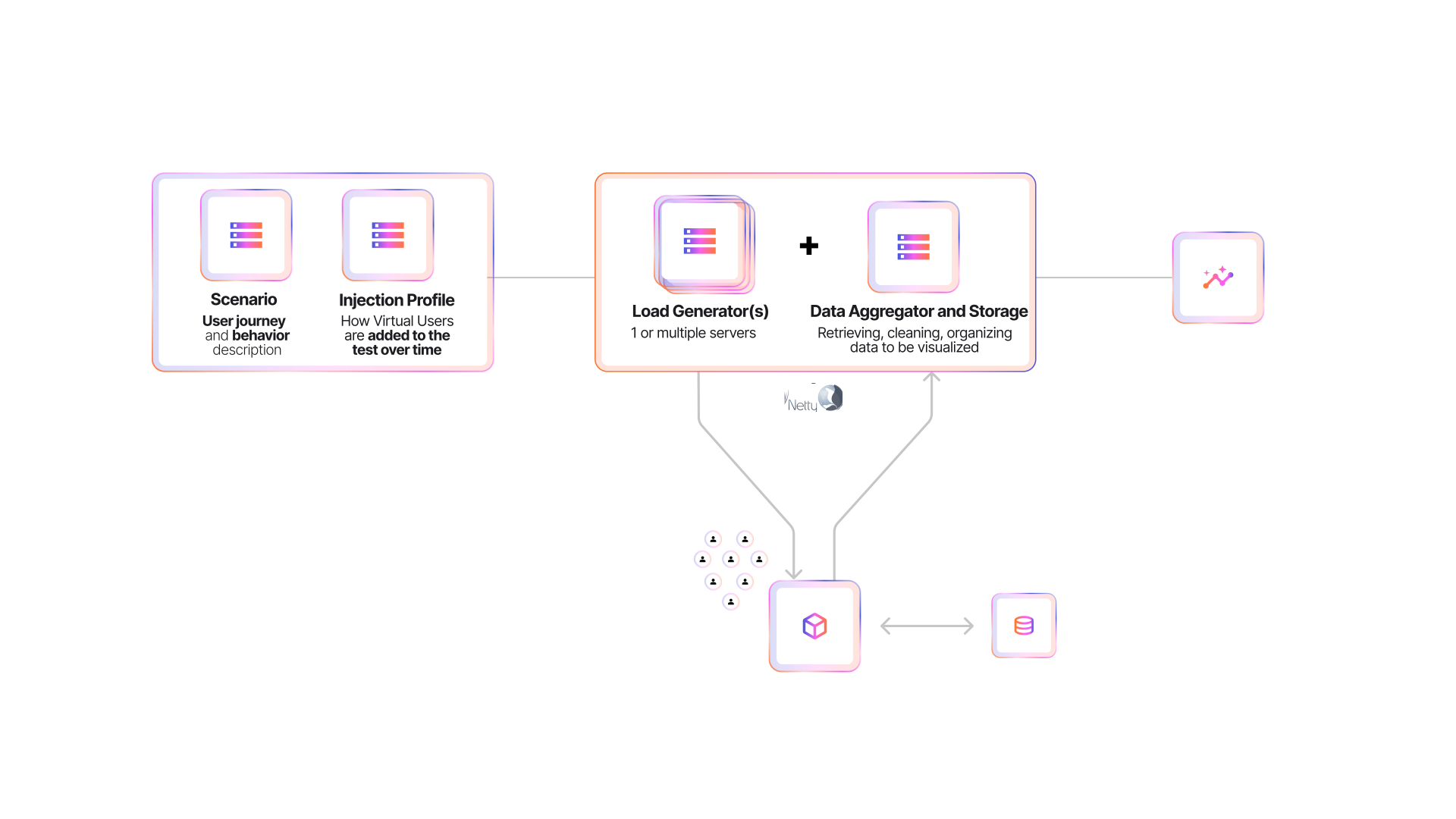
While most legacy tools rely on heavy, thread-per-user architectures, Gatling's engine is fully asynchronous, event-driven, and optimized for massive concurrency, simulating millions of virtual users and sustaining extreme throughput with far fewer machines than traditional solutions.
Operating at the physical limits of a machine
Why Gatling's engine delivers real concurrency, predictable performance, and extreme throughput with fewer machines.
Simulate millions of virtual users, across any architecture
Monoliths, APIs, microservices, Kubernetes clusters, and globally distributed streaming platforms, all handled by the same engine.
What customers reach with Gatling Enterprise Edition
Deployment models for load generation
Gatling Enterprise Edition adapts to any network, security, or infrastructure context.
Gatling-managed load generators
Hosted and operated by Gatling on AWS, pre-configured for optimal performance. Default instance: c6i.xlarge (4 vCPU).
Self-managed load generators
Deploy and manage your own injectors in AWS, Azure, GCP, Kubernetes, OpenShift, or on-premises. Full control over sizing, scaling, and security.
Whichever model you choose, test orchestration, reporting, data aggregation, and scenario execution stay fully centralized within Gatling Enterprise Edition.
Premium support for high-scale testing
Gatling Enterprise Edition includes enterprise-grade support designed for mission-critical load testing.
Architecture & topology
Recommendations tailored to your systems.
Scenario & performance strategy
Design guidance from testing experts.
Debugging
Help finding system bottlenecks.
High-scale configuration
Guidance for demanding test setups.
Injector health monitoring
Ongoing monitoring & troubleshooting.
Best practices
JVM warmup, TLS optimization, scaling patterns.
How to choose your load generation configuration
Whether your services are public, firewalled, or fully isolated on-premises, there's a deployment model built for it.
| Endpoint infrastructure | Testing requirement | Recommended solution |
|---|---|---|
| Public services Internet-exposed |
No strict firewall rules or rate limits | Gatling-managed load generatorsFully managed on AWS |
| Public services with firewall / DDoS protection | Client must allow Gatling traffic through security layers | Gatling-managed with dedicated IPFixed IPs for whitelisting |
| Cloud-native or microservices environments | Need load close to the application to minimize latency | Private locationsCloud-managed |
| Secure or regulated environments | Sensitive data, secret keys, or regulated credential handling | Private locationsCloud-managed |
| Private services Behind firewalls, no direct internet access |
Application or API can't be reached from public networks | Private locationsCloud-managed |
| No access to public cloud providers On-prem, managed datacenters |
Fully isolated infrastructure | Private locationsDedicated machines |
All private-location options deploy across AWS, Azure, GCP, Kubernetes, or OpenShift, with full control over the entire environment.
Ready to evaluate Enterprise Edition?
Whether you're scaling APIs, migrating to the cloud, or handling flash-traffic spikes, Gatling helps you deliver fast, reliable performance.