Whitepaper · Broadcasting & streaming

Performance testing for broadcasting and streaming: when every second of buffering is a business decision

Live sports, OTT subscriber scale, ad delivery, and broadcast modernization. Where streaming platforms break under load, and how to find out before your viewers do.

See Gatling in action

Build, run, and interpret your first load test. A practical session: by the end, you'll know exactly what Enterprise gives you out of the box.

Loading next session...

30 minutes

Live + Q&A

Performance is a business problem

Every platform has its tentpole event

Most broadcast and streaming organizations don't operate at Super Bowl scale. But every one of them has its version of a tentpole event: a match day, a season premiere, a live concert, a product launch stream. And in every case, the moment of peak demand is known in advance.

The traffic spike is foreseeable. The failure, if it happens, is preventable.

The industry is in structural transition. Linear television is moving to IP delivery. OTT platforms compete for attention measured in seconds of startup delay. Ad-supported models turn every failed ad insertion into a revenue event. And live sports, the last category driving appointment viewing, now runs on the same CDN infrastructure as everything else, at 10 to 100 times normal operating load.

In this environment, performance failures are viewer defection events. Research across 150 video services shows that when more than 2% of viewing sessions are subpar, new user churn can reach 50%, more than double the average OTT churn rate in the United States. A buffering ratio above 2% of viewing time is the boundary between a platform viewers trust and one they leave.

The core question is simple: are you managing performance risk, or accepting it?

01

When the world watches at once

Use case: live sports & tentpole events

Live events are the most demanding infrastructure problem in streaming. Traffic does not ramp gradually. It arrives in surges.

CDN providers sustain more than 12 million requests per second during peak live events. Capacity plans built on average traffic don't survive the first minute of kickoff.

10–100x

Traffic surge during major live broadcast events

25–35%

Traffic spike within seconds of a scoring play, as viewers join or replay content

$14,056

Average cost per minute of IT downtime in 2024

The risk journey of a live broadcast event

One tentpole event. Six systems under simultaneous pressure. A 60-second window where failure becomes defection.

  1. Viewer request

    Authentication and session validation

    Risk: Session timeouts under concurrent peak load.

  2. CDN edge

    Content delivery from the nearest point of presence

    Risk: Cache miss rate spikes on new content; origin pulls flood the ingest layer.

  3. Origin servers

    Master playlist and segment delivery

    Risk: At a 5% miss rate and 10M viewers, that's 500,000 simultaneous origin requests.

  4. Video encoding pipeline

    Live transcoding and packaging

    Risk: Encoding latency adds end-to-end delay; segment generation falls behind under load.

  5. Ad insertion

    Dynamic ad insertion at scale

    Risk: Ad decision latency causes buffering; ad timeouts cause content gaps or viewer exits.

  6. Adaptive bitrate delivery

    ABR ladder management per viewer

    Risk: Bitrate degrades at scale; viewers drop to the lowest tier or abandon.

The risk

A CDN that passes capacity planning fails when the top 1% of channels, which carry more than 70% of total platform traffic, all spike at once. Startup failures at kickoff. Buffering during decisive moments. Ad insertion timeouts that turn a 30-second break into a viewer's exit point.

Test beyond game day
  • Simulate the spike, not the average: injection profiles must reproduce simultaneous connection establishment, thousands of sessions starting within seconds. Validate your CDN cache warm-up strategy before the event.
  • Validate capacity under load: AWS recommends a 95% CDN cache hit rate as a planning baseline. That still means 5% of peak concurrent viewers hit your origin at the same time.
  • Test ad insertion under load: run your SSAI/CSAI infrastructure at full event concurrency. A 200 ms ad insertion timeout that passes at 100,000 concurrent viewers may fail at 2 million.
02

Where startup delay is a subscriber decision

Use case: OTT platform reliability & subscriber scale

OTT platforms compete on experience, not just content. With 5.27 billion users worldwide, platform performance is a retention factor.

Startup delays past 2 seconds, buffering above 2% of viewing time, and bitrate drops are problems viewers notice even when they can't name them.

5.27B

Global OTT users in 2024

5.8%

Viewer abandonment per additional second of delay beyond 2 seconds

50%

New user churn when more than 2% of sessions are subpar, over double the average OTT churn rate

The risk journey of a subscriber session

One user opens the app. Six systems must respond correctly, quickly, and in sequence.

  1. Authentication

    Login, token validation, entitlement check

    Risk: Auth service degrades under a login surge on premiere or release day.

  2. Content discovery

    Homepage personalization, search, recommendations

    Risk: Recommendation latency adds to perceived startup time before the user hits play.

  3. Playback initiation

    License acquisition, DRM validation, manifest fetch

    Risk: DRM timeouts cause a black screen; manifest delay is the first buffering event.

  4. CDN delivery

    Segment delivery from edge cache

    Risk: Cache misses on new content force origin pulls at scale on premiere day.

  5. Adaptive bitrate management

    ABR algorithm selects a quality tier per session

    Risk: Rebuffering and bitrate drops, the top causal drivers of quality of experience, rise under load.

  6. Background telemetry

    Playback metrics, heartbeats, quality reporting

    Risk: Telemetry backpressure at scale degrades real-time monitoring.

The risk

Your dashboards tell you when users are already having a bad experience. Without performance testing in your delivery pipeline, you find out after the damage is done.

Test beyond average viewing sessions
  • Make startup latency a metric: past 2 seconds, every additional second costs 5.8% of viewers. Test the full startup journey (auth, DRM, manifest, first segment), not individual endpoints.
  • Simulate premiere day traffic: new releases concentrate traffic in ways normal load profiles miss. Reproduce the login surge, the discovery spike, and cold CDN cache conditions together.
  • Run soak tests: subscription platforms run 24/7, and streaming quality degradation often compounds over time. Soak tests find it before subscribers do.
03

Where performance failures are revenue

Use case: ad delivery & monetization infrastructure

A failed ad insertion is not a user experience issue. It is a direct revenue loss.

Every 100 ms of ad decision server latency at 10 million concurrent viewers is a compounding financial exposure.

16%

Streamed video ads that failed to play globally in Q2 2021, down from 47% in 2018

$1.9B

Annual revenue loss from live-streamed video latency over CDNs in 2021

$9B

Projected accumulated loss through 2026 under HTTP streaming conditions

The risk journey of a video ad impression

One viewer reaches an ad break. The whole chain has under 200 milliseconds to respond.

  1. Ad trigger

    Player signals the ad break to the ad manager

    Risk: Simultaneous ad break signals across millions of sessions create a request spike.

  2. Ad decision server

    Programmatic bid request and creative selection

    Risk: Third-party latency cascades inward. It's your SLA, even when the failure is theirs.

  3. Creative delivery

    VAST tag fetch and media asset retrieval

    Risk: Creative CDN misses on new campaigns cause timeouts before the ad starts.

  4. SSAI stitching

    Server-side ad insertion into the video stream

    Risk: SSAI latency lengthens the ad break gap; stitching errors show the viewer a black screen.

  5. Measurement and attribution

    Ad event data flowing to measurement and attribution systems

    Risk: Handoff points between systems become the weak points under load.

  6. Impression tracking

    Impressions, quartile events, completion

    Risk: Beacon failures invalidate impressions for billing: revenue recognized but not delivered.

The risk

Ad delivery sits at the intersection of real-time video delivery and programmatic advertising, and both have to work together in milliseconds. When they don't, the failure is invisible to the viewer, who sees a black screen or a content gap, but immediately visible in fill rate and revenue reporting.

Test beyond normal ad load
  • Simulate ad break events: on-demand ad calls are staggered naturally across sessions. Live broadcast concentrates them into a single instant.
  • Test ad-to-content transitions: buffering during the switch from ad back to content is disproportionately damaging to viewer experience.
  • Model third-party latency failures: your chain includes external DSPs, SSPs, and ad servers you don't control. Model their latency degradation and timeout behavior.
04

The hidden risk in every migration milestone

Use case: legacy broadcast modernization

Traditional broadcasters are moving from linear delivery and on-premises infrastructure to IP-based, cloud-native architectures.

Every integration milestone is a point where untested behavior under load can quietly undermine the migration's business case.

15–25%

Annual growth in digital viewership for major live sporting events

More outages

Driven by rising demand, legacy strain, and added complexity from 5G and software-defined networking

The risk journey of a broadcast modernization

Legacy systems, cloud migration, and untested load. Silent performance risk at every integration point.

  1. Legacy ingest

    Broadcast ingest and media asset management

    Risk: Stable under known conditions, brittle under the new concurrency patterns of IP delivery.

  2. Transcoding pipeline

    Encoding and packaging for multi-format delivery

    Risk: What worked as scheduled batch processing becomes real-time demand.

  3. API integration layer

    APIs connecting legacy systems to modern delivery

    Risk: Each new wrapper adds latency and a failure surface; integration points weaken under load.

  4. Origin infrastructure

    Content origin for CDN delivery

    Risk: Capacity planning built for linear audiences fails under simultaneous sessions.

  5. Multi-platform delivery

    Simultaneous delivery across web, mobile, and CTV

    Risk: Real peak load per platform doesn't match what the test team modeled.

  6. Operational milestones

    Live events, content launches, seasonal peaks

    Risk: Untested behavior surfaces exactly when the business needs the infrastructure to hold.

The risk

Your monitoring tells you when things break. Without performance testing in your migration process, you miss the window to find out first, while you can still do something about it.

Test beyond the migration checkpoint
  • Validate hybrid architecture: during migration, legacy and cloud-native systems run in parallel. Risk is highest at the handoff points, where requests cross from the old stack to the new one.
  • Simulate your future peak: at this rate of viewership growth, infrastructure sized for today's peak events will be under-provisioned within three years.
  • Add regression detection: embed load tests in the CI/CD pipeline so every release is validated against performance thresholds before it reaches production.
Turning test data into action

Test against the SLOs your dashboards already enforce

Datadog, Dynatrace, New Relic, InfluxDB: your observability stack already defines what good looks like for latency, error rates, and throughput in production. Performance testing applies those same thresholds before production, where regressions are still cheap to fix.

The question isn't monitoring or testing. It's whether your load tests use the same success criteria your dashboards enforce.

Observability
Your APM defines the SLOs
  • p95 latency targets
  • Error rate budgets
  • Throughput baselines
Gatling Enterprise Edition
The same SLOs gate your pipeline
  • Automated pass/fail in CI/CD
  • Compliance score per run
  • Build fails on a p95 breach
Production
Monitoring catches what slipped through
  • Fewer regressions reach viewers
  • Test and prod metrics side by side

Performance testing doesn't replace monitoring. It makes sure less slips through in the first place, moving from a periodic activity to a continuous discipline governed as part of the release process.

High-scale load, secure environment

Simulate the kickoff, not the average

Across every broadcasting and streaming company Gatling works with, one constraint holds: load generators must reproduce the real concurrency patterns of live events, not average traffic.

Unlike e-commerce, where load ramps gradually, live broadcast concentrates millions of connection attempts into a window of seconds. Linear ramps can't reproduce that. Gatling's injection profiles simulate the instantaneous surge your infrastructure has to absorb, across the full streaming API surface: authentication flows, content delivery APIs, ad decision calls, playback reporting, and license acquisition, with JWT, OAuth, dynamic tokens, and chained requests across microservices.

Pro tip

Origin servers, internal ad systems, and legacy ingest pipelines can't be exposed to the internet. For these, load generators running inside your network perimeter aren't a preference, they're a requirement. Private locations deploy them in your VPC, Kubernetes cluster, or data center, without firewall exceptions or architectural compromises.

Example simulation: kickoff surge with SLO-style assertions (JavaScript)
import { constantUsersPerSec, global, scenario, simulation, stressPeakUsers } from "@gatling.io/core"; import { http } from "@gatling.io/http"; export default simulation((setUp) => { const httpProtocol = http .baseUrl("https://api.your-streaming-platform.com") .acceptHeader("application/json"); // The full startup journey, not isolated endpoints const kickoff = scenario("Live match startup") .exec(http("Auth").post("/auth/session")) .exec(http("Entitlement").get("/entitlements/live")) .exec(http("Manifest").get("/live/match/master.m3u8")) .exec(http("First segment").get("/live/match/segment_0001.m4s")); setUp( kickoff.injectOpen( constantUsersPerSec(200).during(300), // pre-match baseline stressPeakUsers(300000).during(60) // kickoff: 300k viewers in 60 seconds ) ) .protocols(httpProtocol) .assertions( global().responseTime().percentile(95.0).lt(800), // per-request budget inside the 2s startup threshold global().failedRequests().percent().lt(1.0) ); });
Gatling Enterprise Edition

Built for broadcasting and streaming services

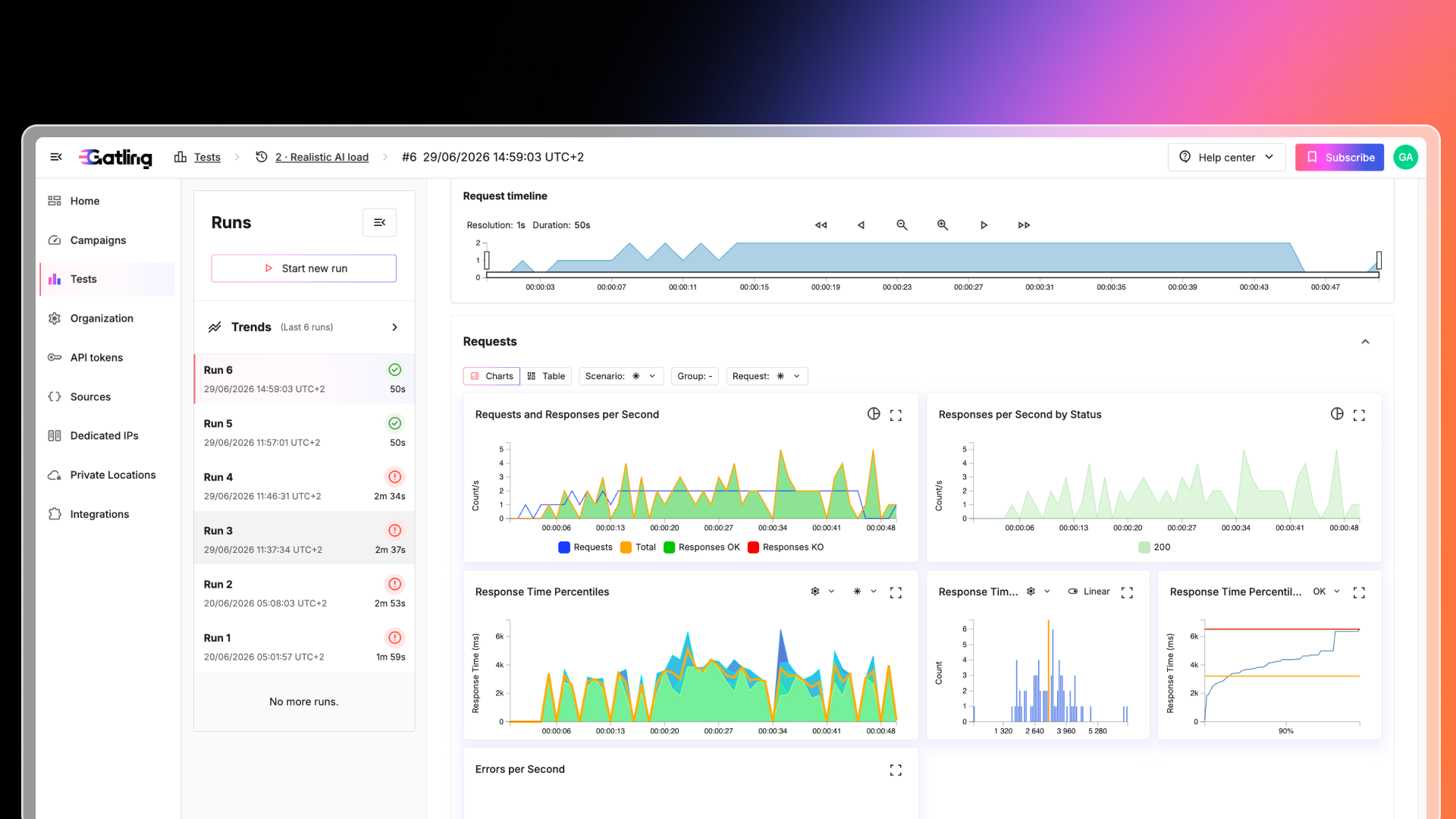
Continuous Performance Intelligence: tests in Git, automation in CI, and results tied to the same telemetry your SRE teams watch on match day.

Private locations

Deploy load generators inside your VPC, Kubernetes cluster, or on-premises data center. Test traffic never leaves your network.

SLOs and compliance scoring

Define p95 and error rate targets. Every run returns a compliance score: the precise share of time your system held the line. Breach it and the pipeline stops.

Enterprise security

SSO (OIDC/SAML), role-based access control, and audit logs that plug into the governance frameworks you already enforce.

AI capabilities

Automated run summaries surface what went wrong without manual analysis. IDE integration and the MCP server bring load testing into the tools your engineers already use.

CI/CD integration

Trigger runs, enforce thresholds, and gate promotions from GitHub Actions, GitLab CI, Jenkins, Azure DevOps, or any pipeline.

Test as code

Java, Kotlin, JavaScript, TypeScript, or Scala. Versioned, reviewed, and living in the same repository as your application.

Supported protocols

HTTP, WebSocket, SSE, gRPC, JMS, and MQTT for APIs, streams, messaging, and microservices.

Comparison and trends

Overlay each run on your baselines to see whether a release improves, holds, or degrades under load.

Infrastructure as code

Spin injector fleets up and down as IaC. Nodes appear in your VPC for the run and disappear after it.

Distributed load generation

Spread injection across multiple nodes and regions so no single machine becomes a CPU bottleneck on TLS-heavy workloads.

What you can achieve

Millions of virtual users, on any architecture

Monoliths, APIs, microservices, Kubernetes clusters, and globally distributed streaming platforms.

60,000

Concurrent virtual users per load generator

300,000

Requests per second per load generator

5M+

Concurrent virtual users with 20 load generators

100+

Load generators running simultaneously

200+

Automated tests running in parallel, 24/7

myCanal · 26.4M subscribers · 52 countries

Progressive capacity, soak, and stress campaigns built in Java, run from private load generators provisioned with Terraform, and wired into GitHub Actions. Bottlenecks in caching and licensing APIs were found and fixed before match day.

Zero incidents during a major football broadcast serving millions of concurrent viewers.

Read the Canal+ story
JioCinema · IPL, Olympics, MotoGP

A wicket or a star batsman walking out can add 7 to 8 million concurrent users within 90 seconds. JioStar reproduces those spikes at match milestones, including OTP login flows that depend on third-party SMS services.

30 million concurrent users supported, without over-scaling infrastructure.

Read the JioStar story

Streaming teams preparing for record-breaking peaks with Gatling

Your next tentpole event is on the calendar

Keep the whitepaper, or see it in action

Take the full whitepaper with you, or see how streaming teams test the kickoff, the premiere, and the ad break before viewers do.

Download

Get the full whitepaper

All four use cases, the kickoff surge example, and the Canal+ and JioStar stories.

PDF · free, no form Download the PDF
Live session

See Gatling Enterprise Edition live

A guided walkthrough with a Gatling engineer, with time for your questions.

Join the next live session