Whitepaper · 2026 roadmap

Introducing Continuous Performance Intelligence: make performance governable

The four pillars that move performance out of the engineering silo and into leadership decisions, the operating model behind them, and six questions every business leader should be able to answer.

See Gatling in action

Build, run, and interpret your first load test. A practical session: by the end, you'll know exactly what Enterprise gives you out of the box.

Loading next session...

30 minutes

Live + Q&A

Performance is a business problem

Performance failures have become a business crisis

When applications slow down, revenue disappears, customers leave, and regulators take notice. Yet in most organizations, performance is still an engineering concern: buried in dashboards leadership never sees, managed after incidents, and disconnected from the decisions that shape the business.

This whitepaper introduces Continuous Performance Intelligence (CPI), Gatling's framework for changing how organizations think about, manage, and govern the performance of their digital systems. Built on four interlocking pillars, CPI moves performance out of the engineering silo and into the domain of leadership.

48%

Of enterprise digital initiatives meet or exceed their business outcome targets. The organizations beating that average share one trait: business and technology leaders co-own outcomes.

Gartner, 2025 CIO Survey

Continuous Performance Intelligence is how that co-ownership becomes operational.

The real problem

The problem business leaders don't know they own

Organizations invest more every year in digital transformation: cloud migrations, platform modernization, AI integration. The outcomes rarely keep pace. Releases slip, deployments fail, incidents reach production, and the customer experience that underpins revenue slowly erodes.

The usual response is more testing: more tools, more engineers, more automation. It keeps failing because it treats the symptom, not the cause.

The real problem isn't that teams run too few tests. It's that performance data never reaches the people who need it most: the leaders deciding on risk, releases, investment, and customer experience.

When engineers say "I don't know what to test," "I don't know what to do with the results," or "I don't know how to convince the business," they aren't questioning load testing. They're questioning its value, and they're right to, because most performance testing is optimized for execution, not for decision-making. Continuous Performance Intelligence closes that gap by making performance data legible, actionable, and shared across the organization.

Let's start with a definition

What is Continuous Performance Intelligence?

A strategic framework, and a category of purpose-built tooling, that turns load testing from a technical activity into an organizational capability.

The shift mirrors what already happened in other domains. Financial reporting became continuous with real-time dashboards. Security moved from periodic audits to continuous monitoring. Customer experience went from annual surveys to always-on measurement. Where load testing asks "How does the system perform under load?", performance intelligence asks broader questions.

Six questions business leaders should be able to answer

Six performance questions for business leaders
0 / 6

Tick the questions your organization can answer clearly today.

These are governance questions, not just engineering ones, and they belong on the leadership agenda. If the answers are unclear, or known only to engineers, the organization has a performance intelligence gap. It's manageable, but closing it takes a deliberate decision to start.

From isolation to a continuous system

The Continuous Performance Intelligence operating model

Six layers, each built on the one below, all anchored in business strategy.

AI intelligence layer

Guides intent · Assists execution · Explains signals · Advises decisions

Scalable shared capability

Expert amplification · Team enablement · Learning loops

Governance, risk, and economic control

Auditability · Compliance · Guardrails · Cost visibility

Signal intelligence and decision support

Baselines · Comparisons · Regression detection · Scores

Continuous and realistic validation

CI integration · Production-like workloads · Automation

Strategic intent and structured test management

Objectives · Campaigns · Applications · Ownership

Business strategy

  1. How it compounds
  2. Intent drives validation
  3. Validation produces signals
  4. Signals support decisions
  5. Governance builds trust
  6. Shared capability scales adoption
01

Performance methodology: from running tests to defining intent

Laying the foundation: before any test runs, answer one question. What are we actually trying to protect?

Most teams can't answer it clearly. Tests exist because they always have. Scenarios were written by someone who has since left. Load is generated because the tool needs a target. Without intent, performance testing is a ritual, not a risk management practice.

Performance methodology means structuring testing around explicit business objectives, defining Service Level Objectives (the thresholds where performance becomes a business problem), and organizing tests into campaigns with a clear purpose: what risk does this test reduce, and what decision does it inform?

For business leaders, it delivers two things most organizations lack. A shared language, where "checkout must respond within 300 ms for 99% of requests at peak load" is as clear to product and commercial leaders as to developers. And a governance model organized around business domains, not test runs that disappear into a log. Leaders can then ask "Are we meeting our performance commitments?" and get a concrete, data-backed answer.

In Gatling Enterprise Edition

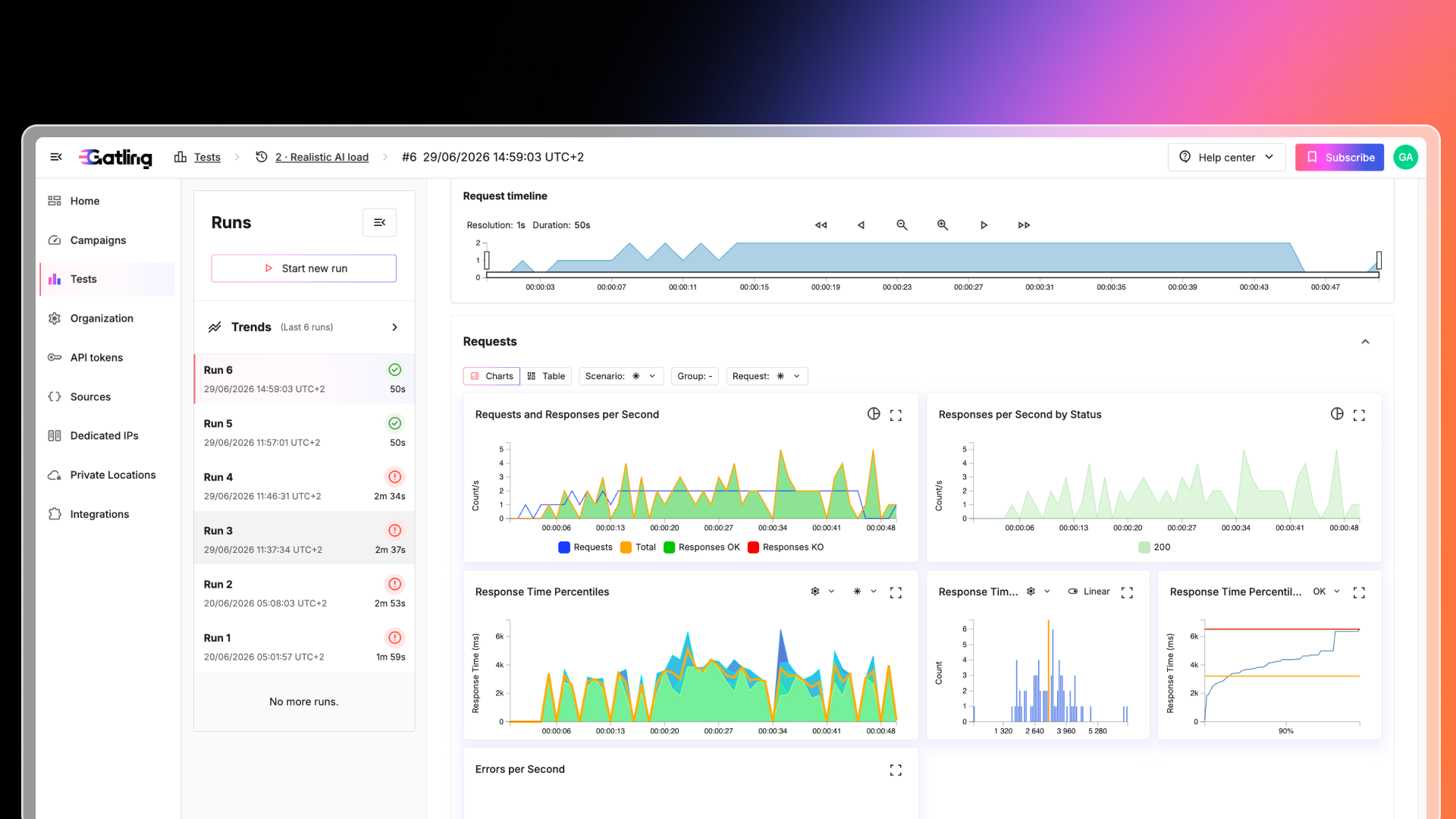
Campaigns are structured test programs built around a specific goal or application domain, and Projects group campaigns into application-level governance. SLOs are defined directly in the platform, turning subjective pass/fail judgments into explicit, measurable commitments.

02

Decision enablement: from metrics to actionable direction

Creating a decision framework: excellent tests and complete data still ship incidents when no one knows what the results mean.

Data without interpretation is noise. Dashboards without owners are decoration. Metrics without thresholds are observations without conclusions. The gap between "we have data" and "we made a decision" is where most performance value is lost.

Decision enablement turns performance signals into clear direction. It takes three things working together: observability context that connects test results to real system behavior, analysis that surfaces what matters, and a performance score that tells leadership at a glance whether objectives are met.

$2.41 trillion

The cost of poor software quality in the United States alone.

CISQ, Cost of Poor Software Quality in the US, 2022

For business leaders, this pillar answers the question that usually goes unanswered: should we ship? Not as a gut call or an isolated engineering judgment, but as a documented, evidence-based decision. The conversation shifts from "the tests passed" to "here is our performance position, here is the risk, here is the recommended course of action."

In Gatling Enterprise Edition

APM integrations with Datadog, Dynatrace, InfluxDB, New Relic, and OpenTelemetry bring observability context into test results. AI-powered results analysis highlights the signals that matter and suggests next steps in plain language. Campaign and Project scores roll performance data into a single indicator a CTO can read without a briefing.

03

Shared capability: from engineering activity to organizational governance

Giving business teams visibility: make performance visible beyond engineering.

Shared capability means building the dashboards, reporting structures, and governance mechanisms that let leadership, product, and commercial teams engage with performance data without needing to understand its mechanics.

It isn't about teaching non-technical leaders load testing. It's about giving them what they need to do their jobs: govern risk, allocate investment, and hold engineering accountable for outcomes that matter to the business. Performance then sits next to revenue, customer, and operational data in the dashboards leadership already uses.

This is the pillar that turns performance from a technical activity into a leadership responsibility, and creates the co-ownership that defines the organizations beating their digital targets.

In Gatling Enterprise Edition

The Usage Dashboard shows engineering leaders adoption, engagement, and coverage across the organization, so performance culture becomes measurable. Automated reports at campaign and project level send performance summaries to the right stakeholders on a regular cadence, with no one pulling data by hand.

04

AI as a continuous companion: from assistance to intelligence

Leveling the playing field: the fourth pillar makes the other three scalable.

Performance expertise is scarce. Defining meaningful test strategies, interpreting complex results, and advising on architectural risk takes deep, specialized knowledge that most teams don't have enough of. AI doesn't replace that expertise. It amplifies it, making it available to teams without a dedicated performance engineer and far more productive for teams that have one.

20–50%

Productivity gains for individual developers using AI coding tools, and around 10% at team level.

McKinsey research

AI also keeps tests current. Every architectural change (a new service, a different payload, a new scaling strategy, a move to event-driven communication) changes performance behavior. AI-assisted tooling flags mismatches between simulations and recent changes, suggests updates, and highlights coverage gaps, so teams refine tests instead of rewriting them.

And it carries results beyond engineering. Most performance data never leaves the engineering team, not because engineers hold it back, but because translating it into business language is slow and rarely prioritized. With AI, a product leader understands what a test found without a briefing, and a CTO gets a summary of the organization's performance commitments in the time it takes to read an email.

Organizations investing in AI-assisted development without performance intelligence risk generating code faster than they can assure its quality. CPI is the baseline, quality gates, and measurement that let AI speed up delivery without compounding technical debt.

In Gatling Enterprise Edition

AI is embedded across the performance lifecycle, not bolted onto a dashboard. The AI IDE assistant helps engineers write and refine test scripts in their development environment. The AI Campaign Design Assistant helps teams define what to test, how to structure it, and which objectives to set. AI test results analysis surfaces what matters, recommends next steps, and writes plain-language summaries non-engineers can use.

What changes

What changes when all four pillars are in place

Continuous Performance Intelligence isn't a tool to deploy or a project to complete. It's an organizational posture: a lasting shift in how performance is understood, governed, and used. The change shows at every level.

For the board and C-suite
  • Performance becomes governable
  • Reports and signals inform product decisions
  • Performance scores replace incident reports
  • Investment decisions rest on evidence, not engineering intuition
For product and commercial leaders
  • Performance commitments become explicit and measurable
  • SLOs become customer experience standards product teams own and commercial teams can communicate
  • When performance degrades, the right people know before customers do
For engineering and tech leaders
  • Performance becomes a capability, not a department
  • AI handles the heavy lifting, so engineers focus on work that needs human judgment
  • Conversations with leadership move from explaining what went wrong to showing what's measured and what's being done
For the organization as a whole
  • Performance is anticipated instead of reacted to
  • Ship decisions are made with evidence, not hope
  • Performance knowledge compounds over time instead of resetting with every team change or migration
From load testing to performance intelligence

The cost of treating performance as a technical problem has never been higher

Modern distributed systems are too complex for any single engineer to fully understand, and the stakes (revenue loss, regulatory exposure, reputational damage) grow with every wave of digital investment.

Continuous Performance Intelligence doesn't make performance easier. It makes it governable. The four pillars (performance methodology, decision enablement, shared capability, and AI as a continuous companion) are a blueprint for organizations that want performance anticipated rather than reacted to, and leaders confident enough to act on what they find.

Execution was phase one of load testing. Intelligence is phase two.

Ready to implement Continuous Performance Intelligence?

Keep the whitepaper, or see it in action

Take the four pillars to your next leadership meeting, or see how AI-assisted performance testing works in a live session.

Download

Get the full whitepaper

The four pillars, the operating model, and the six questions for business leaders.

PDF · free, no form Download the PDF
Live session

See Gatling Enterprise Edition live

A guided walkthrough with a Gatling engineer, with time for your questions.

Join the next live session