Where homegrown load testing gets expensive, what a platform has to handle at scale, how to compare total cost of ownership, and a 10-point checklist to decide if you should keep building.
Live Session
Build, run, and interpret your first load test. A practical session: by the end, you'll know exactly what Enterprise gives you out of the box.
Loading next session...
30 minutes
Live + Q&A

Spinning up a single test is simple. Running a trustworthy, distributed, pipeline-driven performance platform that serves multiple teams is not. Many teams start with open source to validate behavior, then find that maintaining orchestration, analytics, integrations, and security turns into a hidden burden.
Users expect your application to feel as fast as the best in the world. That turns performance testing from a late-stage check into a continuous quality engine.
Microservices, edge, and hybrid cloud make realistic test scenarios distributed by design. And raw metrics aren't enough: teams need actionable insights, gated pipelines, and reliable governance. When evaluating options, most teams compare two paths.
Great for validating key flows and getting a first test into CI. You own everything around it.
Orchestration, analysis, integrations, and governance are handled, so teams focus on the tests.
Teams usually build for control, flexibility, or cost. The deeper complexity tends to surface once more teams, regions, and pipelines depend on the platform.
You coordinate generators across locations, retry logic, time sync, and result collection, and handle partial failures gracefully. That's ongoing engineering, not a one-off script.
High-cardinality time-series data has to be aggregated and retained so teams can compare runs and spot regressions quickly. Without that, people fall back to manual diffing and intuition.
CI vendors, runners, and APM tools keep changing. Keeping pipelines green means maintaining plugins, CLIs, and webhooks, and every broken connector costs confidence in testing.
SSO, RBAC, group-to-role mapping, quotas, auditing, and shareable reports are mandatory for cross-team adoption. Building and operating them well is not trivial.
Every hour spent keeping a homegrown platform alive is an hour not spent shipping product. Unless performance testing is your product, it's rarely the best use of your engineers.
DIY is great for exploring. At scale and over time, the operational surface area (distribution, analysis, integrations, and security) becomes the work.
Use open source or lighter tooling to validate key flows before investing in scale. Define your critical user journeys, test them in staging or dev, and check that your assertions make sense. Gatling supports JavaScript, TypeScript, Java, Scala, and Kotlin, and imports Postman collections to cover real flows faster. Start with a few key scenarios, simple assertions, and a first CI job.
Vertical scaling (one big host) hits limits quickly and can skew results. Distributed load generation lets you model global traffic patterns and regional failover, avoid single-host bottlenecks and noisy neighbors, and keep sensitive traffic in-network with private locations while still using a central UI and APIs for control and analysis.
This is where "build" turns into "operate a product." A platform that already handles generator lifecycle, placement, and network constraints saves significant toil.
Performance testing should protect releases, not slow them down. Run tests in CI on pull requests, merges, and on a schedule for long-running scenarios. Use stop criteria and performance gates to fail the pipeline when SLOs are breached, and compare runs to see exactly what changed between builds.
Successful programs make performance a shared responsibility. Your solution has to work for every role involved.
Code-first authoring and fast feedback loops
Dashboards, alerts, drill-downs, and trend analysis
Shareable reports, project views, budgets, and quotas
SSO, RBAC, audit trails, and tenancy boundaries
If adoption requires manual workarounds or permission silos, performance testing becomes an afterthought instead of part of engineering culture.
A mature platform ships these as table stakes. A homegrown stack has to evolve them deliberately.
Compare lifecycle costs and time to value. Once continuity, governance, and adoption are factored in, a managed platform often ends up cheaper and far less risky.
Building and maintaining orchestrators, data, dashboards, and plugins
Compute, storage, egress, and capacity planning
CI, APM, and identity systems keep changing
Who gets paged when the test platform flakes?
Features and fixes your team didn't ship
| Dimension | BuildIn-house solution | BuyEnterprise platform |
|---|---|---|
| Time to value | Fast to prototype or run a first POC, then slows sharply as you scale across teams or regions. | Ready from day one, with faster onboarding and immediate value at scale. |
| Distributed orchestration | You design and operate control, scheduling, retries, and data aggregation. | Handled by the vendor, with consistent APIs and lifecycle management. |
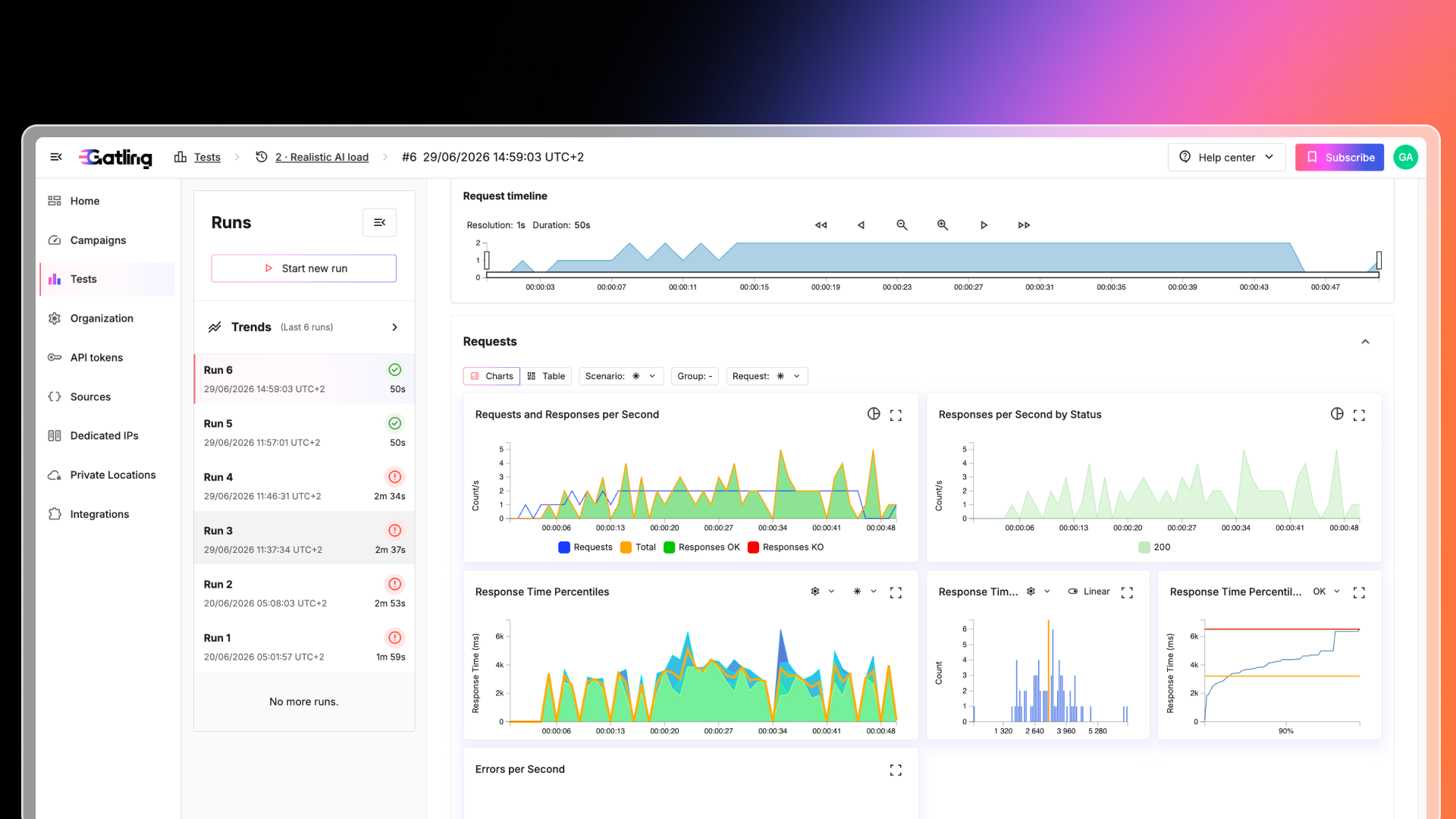
| Metrics and analysis | You stand up a time-series database, retention, trends, and comparisons, and maintain them indefinitely. | Built-in aggregation, trends, and run comparison to catch regressions quickly. |
| Automation and CI/CD | You maintain scripts and plugins as ecosystems evolve. | Native plugins for any CI path, with stop criteria and gates to protect releases. |
| APM and alerts | You write and maintain an integration per tool. | Documented, supported hooks and webhooks. |
| Security and governance | You build SSO, RBAC, and quotas, and keep mappings and policies current. | Enterprise SSO, RBAC, quotas, and audit built in. |
| Deploy anywhere | Custom work to keep traffic in-network or on-prem with central control. | Private locations run generators in your cloud or on-prem, with one-way control. |
| TCO and team focus | Lower upfront cost, rising operating cost and on-call, ongoing roadmap burden. | License cost offset by less platform toil and a predictable evolution path. |
| Choose this when | Your requirements are highly unique, strategic, and tied to your product. | Your needs are common and repeatable at scale, and extensible through APIs and integrations. |
Tick every statement that's true for your team today.
Tick the statements that are true for your team today.
It isn't black or white, and it isn't a forced path. You can keep using Gatling Community Edition locally to author tests (in JS, TS, Java, Scala, or Kotlin, or from a Postman import) while the platform handles scale, analysis, and governance.
Your users expect speed and reliability, and your load testing platform has to deliver the same. Gatling Enterprise Edition is built around five pillars.
Real-time visibility with dashboards, trend comparisons, and actionable insights.
Code, low-code, or no-code: script in JavaScript, TypeScript, or Java, import Postman, or design visually.
Trigger simulations from CI/CD or the API, apply stop criteria, and gate releases with performance thresholds.
RBAC, SSO, quotas, and shared reports. Share results in Slack, Teams, or Jira.
Run tests from Gatling-managed regions, your own cloud, or on-prem.
Take the full ebook to your next build vs. buy discussion, or see what you'd stop building yourself.
The risks of building, the TCO comparison, and the 10-point checklist.
PDF · free, no form Download the PDF downloadA guided walkthrough with a Gatling engineer, with time for your questions.
Join the next live session arrow_forward